Art Appreciation: The Art World goes BOOM
Thursday, September, 10th, 2015
This is an entry to the Arts Future Classroom Competition 2015. Share your class with the Arts Future Classroom educators community here.
Art Appreciation: The Art World goes BOOM aims to provide a basic introduction to, and appreciation for, art.
This course explores the nature of art in various aesthetic, formal, and social dimensions through a combination of lecture, discussion, hands-on activities, and experiential learning. This involves the analysis of art objects, mediums, and the functions of art in order to provide understanding, enjoyment, life enhancement, and a wellspring of knowledge for witty banter at parties. These are higher level thinking skills that are applicable in any field or discipline. The focus of this course is on a non-traditional approach that aims to challenge and engage non-art majors in critical thinking about art.
- Class size:
- Minimum: 10 students
- Maximum: 40 students
- Suggested venue(s):
- The most successful delivery of this course integrates a variety of venues. By moving between a myriad of venues, students are encouraged to break out of the conditioned and expected behaviors of the traditional classroom arrangement and delivery. Changing venues facilitates greater engagement and interaction between students, but can also enhance experiential learning by pairing the specificity of the site with the content of the lesson.
- Some suggested venues include:
- A lecture hall where students can use their own laptops
- An art gallery or museum
- Outdoor sculpture park
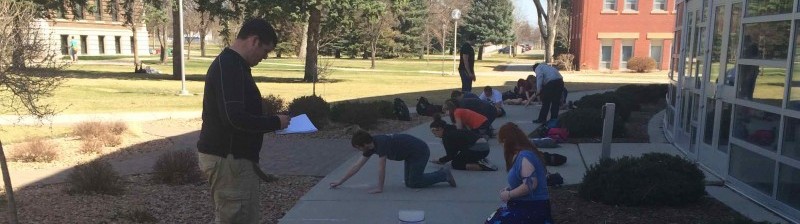
- An outdoor space that allows for movement
- A coffee shop
- A quiet gathering place on campus
- A library
- Specialized field trip locations:
- Cemetery
- Monument
- Church or other religious building
- City park
- Restaurant
- Lesson details:
- I infuse everything that we do with a little bit of humor. I do not approach this course as a regular art history course, rather I have taken the opportunity of rethinking how an appreciation for art can be demonstrated and communicated using elements of the flipped classroom, experiential learning, hands-on activities, and a variety of technology. I often focus on the quirky, silly, or obscure side of artists and the art world – this is the stuff that I am interested in and makes for great discussion content.
- Week One: What is Art? What is Art for?
- Week Two: The Language of Art and Architecture/Campus Art Tour
- Week Three: Types of Media / Happenings
- Week Four: Who Makes Art?
- Week Five: Plato – group discussion
- Week Six: What Do We use Art For? / Dada Poem Art Project
- Week Seven: Aristotle – group discussion
- Week Eight-Nine: Why Do We make Art? / Marking the Landscape Activity
- Week Ten: Art and Technology
- Week Eleven: Art and Social Justice
- Week Twelve: Street Art / Altered Masterpiece Art Project
- Week Thirteen: Tableaux Vivant Art Project
- Week Fourteen: Mortality and Immortality in Art
- Content materials and resources:
- There are a wide variety of resources that can be used for this course, and most of them are found online. If you use slide presentations, try to interject them with other resources. You can use joke books, internet memes, online articles, funny or informative videos, and blogs. Here are a few of the resources that I utilize:
-
- Equipment/ tools necessary
- Classroom with a computer/projector/speakers
- Scissors and glue
- Sidewalk Chalk
- Cameras or phone camera
- Snacks or treats…who doesn’t like eating cookies while looking at art?
- Evaluation/ Grading System:
- You can utilize traditional quizzes but include silly questions, or questions that have come straight out of our in-class discussions – nothing is off limits in terms of what we discuss and what might show up on a quiz. You can also use gallery reviews, image journal entries, and creative projects (some examples include constructing a Dada poem based on Tristan Tzara’s “How to Write a Dada Poem” or in small groups create tableaux vivants of famous historical paintings).
- 1. Creative Projects (20pts x 3 assignments = 60pts)
- 2. Critical Responses (40 pts x 2 = 80pts)
- 3. Quizzes (25 points x 4 = 100pts)
- 4. In-Class Projects (20 points x 2 = 20pts)
- Possible complications:
- Depending on the place of delivery for this course, there may not be access to varying venues for teaching. If you are creative, even getting out of the same classroom that you typically utilize can be effective.
- Depending on your budget, you may not be able to purchase some of the simple materials need to the hands-on activities. Cheap or free alternatives can often be found.
- Inspiration:
- After teaching this course for several years and noticing a low level of engagement amongst the students, I was inspired to try a different approach than the standard lecture style delivery. I also came to the harsh but truthful realization that most of the students in the class have no interest in art, and will only be taking this one art class in their entire college career. So I asked myself: what kind of experience should they be having? What impressions of art will they take away from this course? How do I get them excited to think about art?
- Instructor’s Evaluation:
- Since this is an introductory course, I have stayed away from any heavy theory or in-depth historical analysis. We do discuss Plato and Aristotle’s theories of art, because they play off of one another so well, but that is as far as we go into theory. This is not to say that I have dumbed down the course, but I have simply replaced prolonged serious theoretical discussions and papers with alternatives that require more engagement and experiential learning from the student. I have noticed a marked difference in the overall atmosphere of the classroom. The students have also become more willingly to have a discussion on a topic that we have encountered through hands-on or experiential means.
- Attendance is also improved because the students are excited to see what we will be from one class to the next.
- Submitted by: Greg Blair, PhD | Northern State University, Aberdeen, SD, USA | Email | Website




 Facebook
 Twitter
 Google+
 Amazon